Hormuz Strait in a War Zone: Networked Infrastructure and Multimodal Resilience

Introduction
The Strait of Hormuz is often described as the world’s most critical energy chokepoint.
But on April 12, 2026, following the conclusion of U.S.–Iran talks without agreement, real-time vessel tracking suggests something more subtle and more important:
The system did not stop. It starting to be reconfigured by stakeholders and players.
The AIS (Automatic Identification System) data do not show typical dense transit through the Strait.
Instead, they reveal a network adapting under stress.
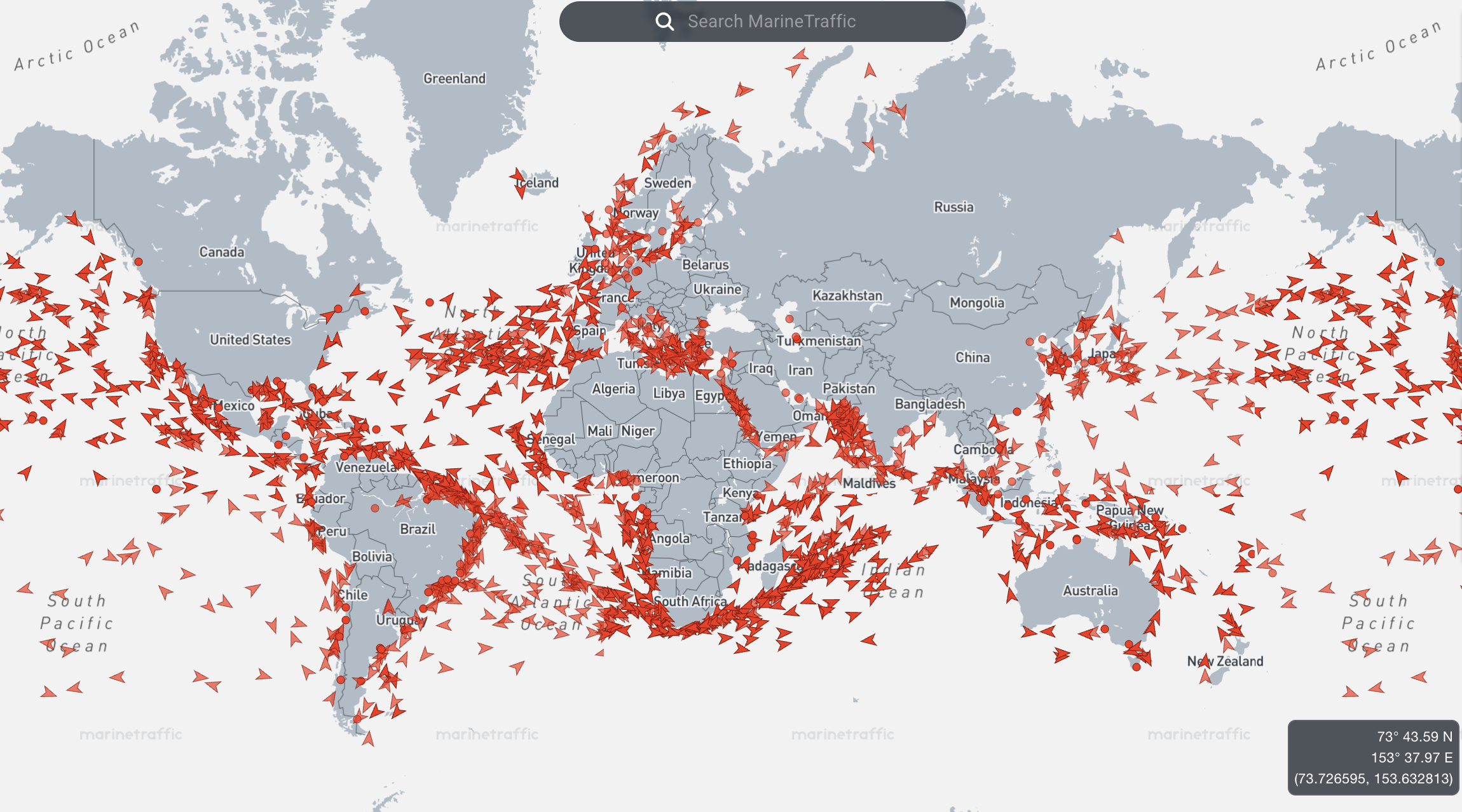
Global Context: Energy Transport as a Network
Global tanker traffic forms a dense and interconnected system:
- Atlantic basin routes linking the Americas and Europe
- Mediterranean and Suez corridors
- Indian Ocean routes toward Asia
- Pacific distribution networks
These flows represent:
A continuous, networked movement of energy, not isolated routes.
Disruptions at key nodes propagate globally through timing, cost, and uncertainty.
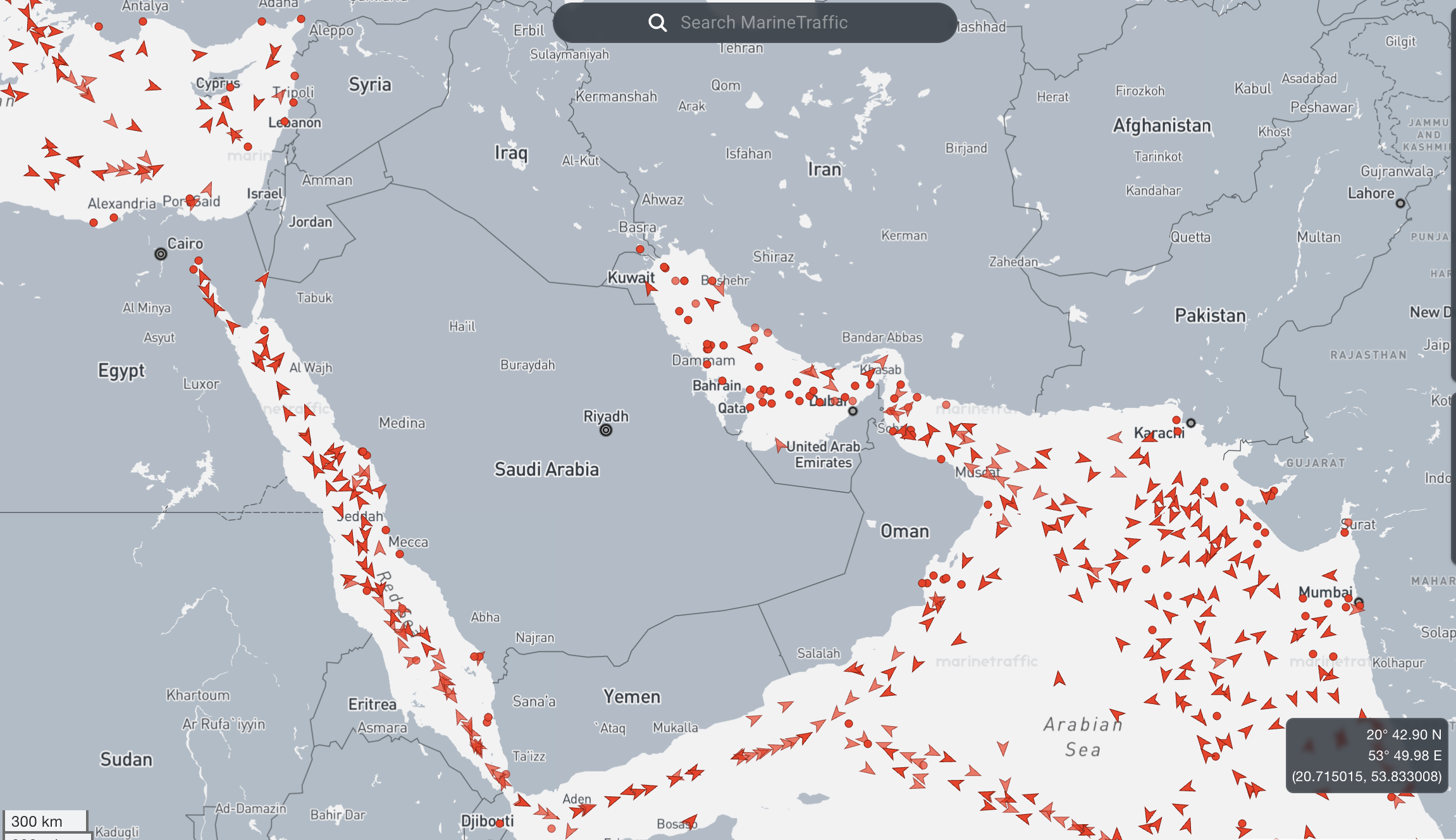
Regional Context: The Arabian Gulf Under Tension
Zooming into the Middle East reveals:
- Heavy vessel presence across the Arabian Gulf
- Strong clustering near major ports
- Active flows in the Gulf of Oman and Arabian Sea
However, the most important observation is not density — it is distribution.
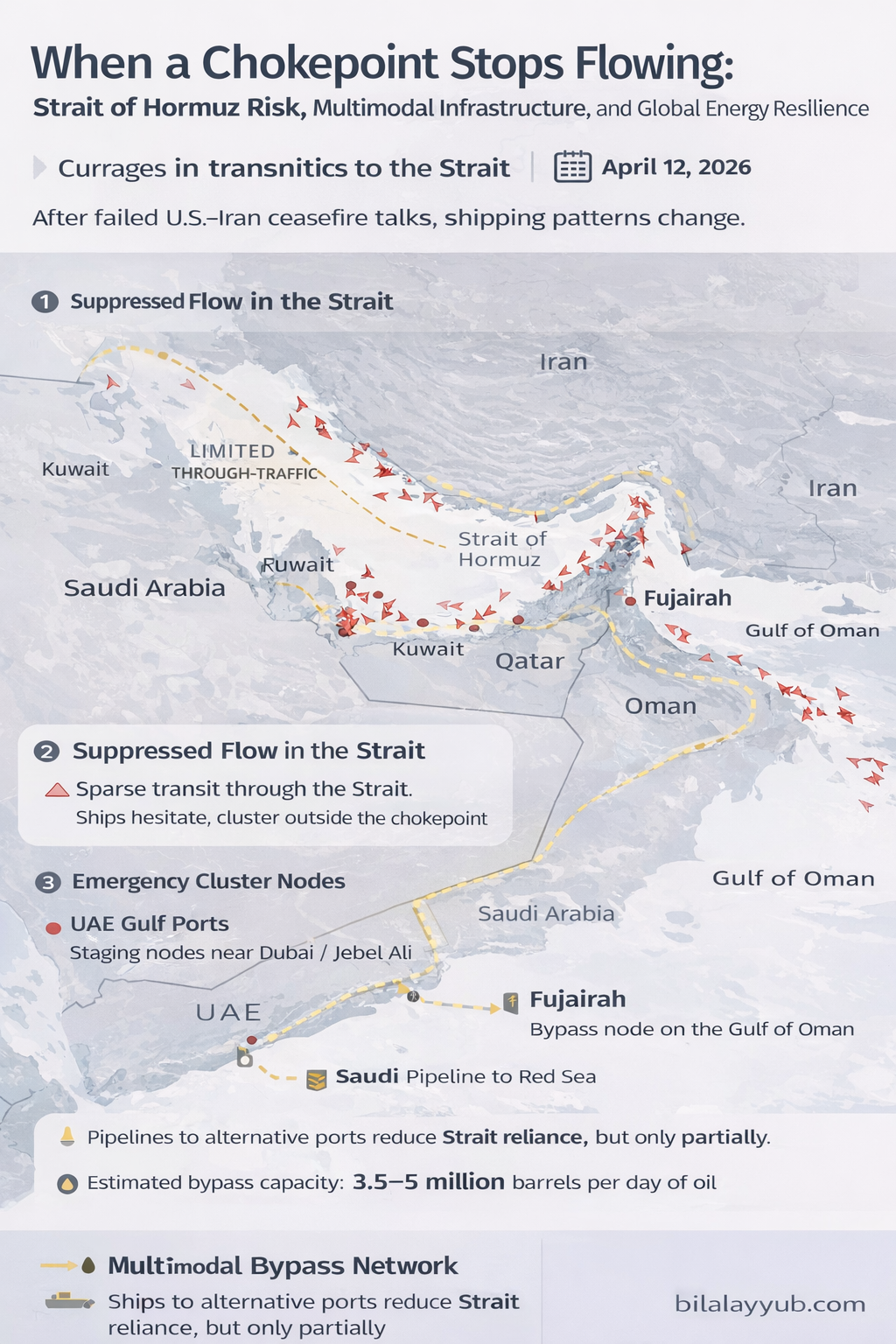
The Strait of Hormuz: Suppressed Flow
Contrary to expectations, the Strait itself shows:
- Relatively low through-traffic
- Reduced continuous transit patterns
- Increased dwell time near entry/exit points
This aligns with external reporting describing reduced or disrupted transit during periods of escalation.
The chokepoint is not congested — it is constrained.
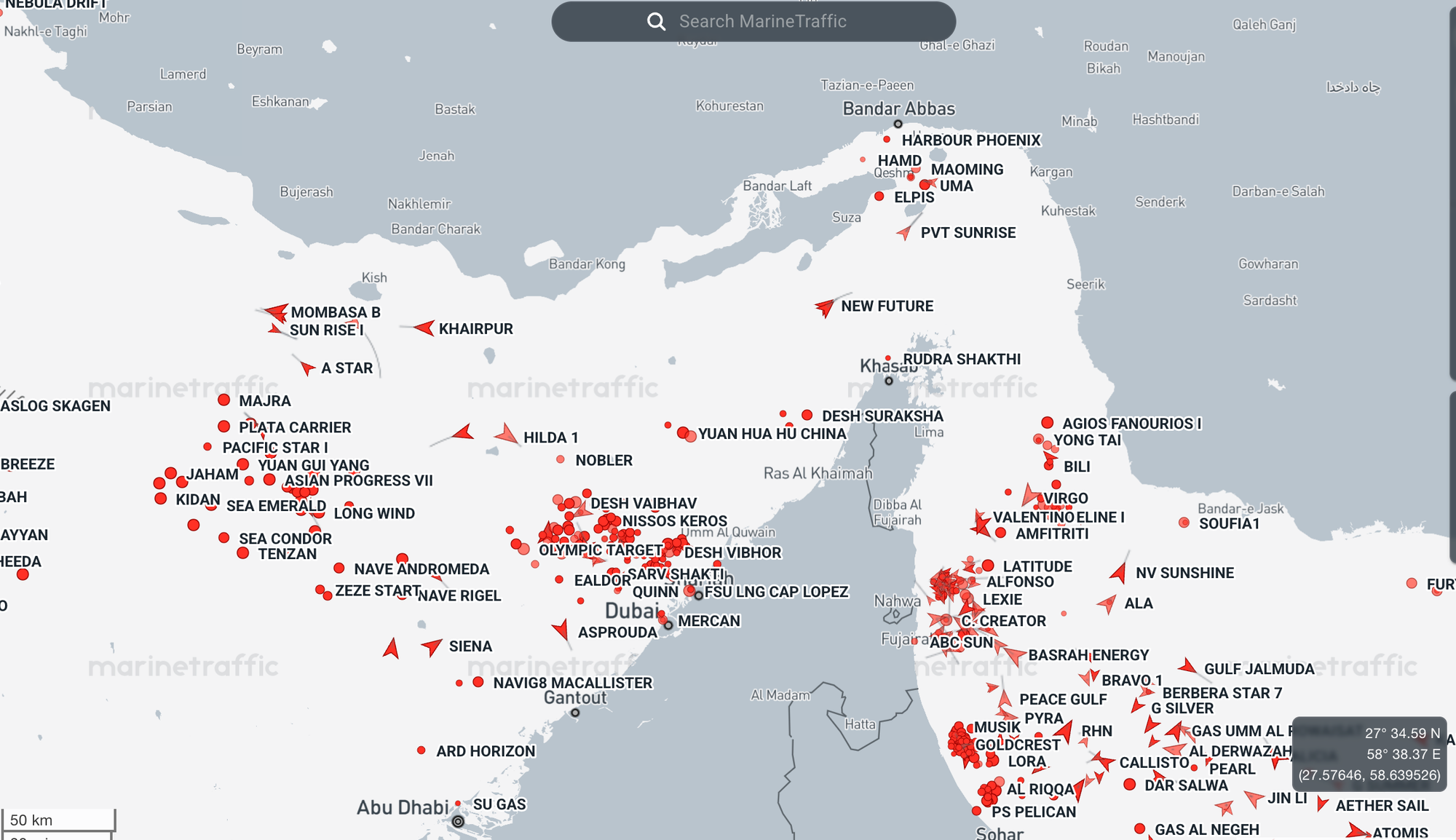
Emergence of Clusters: A Network Response
Instead of flowing through the Strait, vessels appear to reorganize around it.
1. Gulf-Side Buffer Nodes
High-density clustering is visible near:
- Dubai / Jebel Ali
- Nearby UAE Gulf ports
These act as:
- Holding zones
- Commercial staging areas
- Decision points for onward movement
2. East-of-Strait Bypass Nodes
A second cluster emerges near:
- Fujairah
- Gulf of Oman
This is particularly significant.
Fujairah serves as:
- A major bunkering hub
- A storage and export node
- A strategic location outside the narrowest risk zone
In stressed conditions, Fujairah becomes a system-level safety valve.
3. Decision Corridors
The Strait itself becomes:
- A zone of hesitation
- A strategic bottleneck
- A point of risk assessment
Ships approach, wait, or divert — rather than flow continuously.
Vessel-Level Insights
The zoomed AIS image of April 12, 2026 shows a diverse set of vessels, including:
- Yuan Hua Hu China
- Desh Vaibhav / Desh Vibhor
- Olympic Target
- Nave Andromeda / Nave Rigel
- Mercan
- FSU LNG CAP Lopez
- Agios Fanourios I
- Valentine Jolie I / Amfitriti I
On the Gulf side:
- Mombasa B
- Khairpur
- Sea Emerald
- Nave Andromeda
- Nave Rigel
These names reflect:
- Global participation
- Mixed ownership structures
- LNG and crude transport
- Multi-country exposure
The chokepoint is not regional — it is global in impact.
Multimodal Reality: Can the Strait Be Bypassed?
A key question arises:
Can land transport replace maritime flow?
The answer is: not directly.
Instead, the system relies on multimodal energy infrastructure, primarily pipelines.
Key alternatives include:
- Saudi Arabia’s East–West pipeline to the Red Sea
- UAE pipelines delivering crude to Fujairah
These systems provide:
- Partial bypass capacity
- Strategic flexibility
- Reduced reliance on Hormuz
However:
Total pipeline capacity is significantly lower than total maritime flow.
This creates a partial, not complete, substitution.
Before vs. After: System Behavior
Pre-escalation
- Continuous transit through the Strait
- Predictable flows
- Limited clustering
During escalation
- Reduced transit
- Vessel hesitation
- Increased congestion
April 12 snapshot
- Suppressed through-flow
- Strong clustering at nodes
- Strategic repositioning
The system shifts from flow to buffering.
Economic Implications: Beyond Prices
The impact is not only price increase and volatility.
It is structural.
1. Logistics Become the Constraint
- Waiting times increase
- Delivery schedules shift
- Supply timing becomes uncertain
2. Ports Gain Strategic Importance
- Fujairah becomes critical although within the war zone
- UAE Gulf ports act as buffers although within the war zone
3. Optionality Becomes Uneven
- Countries with pipelines gain flexibility
- Others remain exposed
4. System Risk Becomes Network Risk
Disruption propagates through timing, routing, and coordination — not just volume.
Ayyub (2014) provides analytical methods and insights in the book Risk Analysis in Engineering and Economics (https://www.routledge.com/Risk-Analysis-in-Engineering-and-Economics/Ayyub/p/book/9781032918006)
Systems Insight: Play the Players
This is where infrastructure meets behavior:
Play the Players for Winning Peace: Complexity Analytics with the UK-Ireland Good Friday Agreement as a Case Study
https://scholarworks.umb.edu/nejpp/vol37/iss1/7/
Actors in the system:
- Shipowners
- Charterers
- Port operators
- States
- Insurers
Do not simply stop operations.
They:
- Delay
- Cluster
- Reroute
- Hedge
- Signal stability
The AIS map is a real-time record of strategic behavior under uncertainty.
Conclusion
The Strait of Hormuz is not just a passage.
It is:
- A chokepoint
- A decision node
- A system stress indicator
When it is constrained:
- Flow does not disappear
- It reorganizes
Understanding this requires:
- Systems thinking
- Network analysis
- Behavioral insight
The most important signal is not movement — but change in pattern exhibiting a complex system behavior in which players change behavior based on the emerging state of the system.
Sources
- MarineTraffic AIS data (April 12, 2026, 6:30 PM EST)
- Al Jazeera reporting on U.S.–Iran talks
- Play the Players for Winning Peace: Complexity Analytics with the UK-Ireland Good Friday Agreement as a Case Study
https://scholarworks.umb.edu/nejpp/vol37/iss1/7/ - Risk Analysis in Engineering and Economics (https://www.routledge.com/Risk-Analysis-in-Engineering-and-Economics/Ayyub/p/book/9781032918006)
- IEA and EIA analysis of Hormuz and pipeline capacity