Nuclear Deterrence Failure in Complex Systems: Comparative Consequence Pathways and Resilience Across Scenarios

A systems-based analysis of infrastructure, food, water, and recovery dynamics
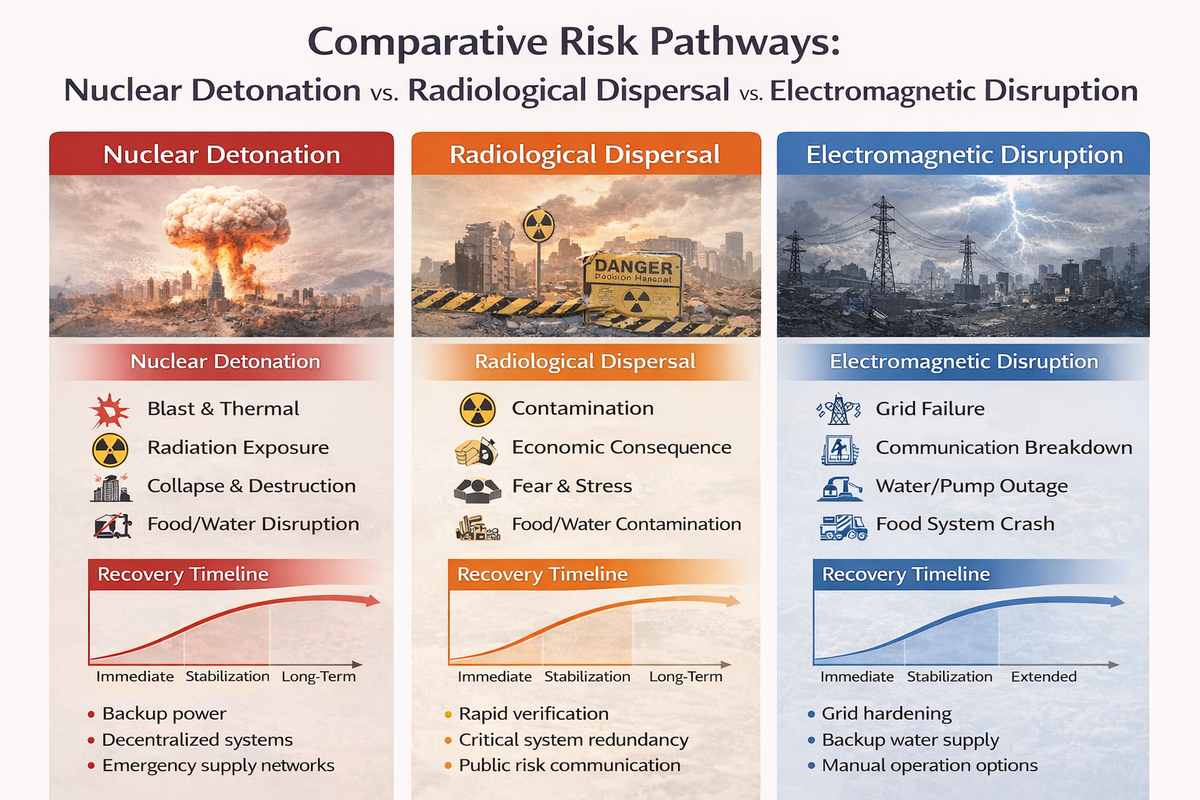
Three broad classes of catastrophic risk are often discussed: (1) Nuclear detonation, (2) Radiological dispersal (dirty device), and (3) Electromagnetic disruption (EMP). They are examined from effects to recovery to inform policy and planning.
1. Nuclear Detonation — Multi-System Collapse
Primary Consequence Pathways
- Physical destruction (blast, thermal effects)
- Radiation exposure
- Infrastructure collapse (energy, water, transport, health systems)
Food and Water Impacts
- Immediate disruption of water supply systems (pumping, treatment, distribution)
- Potential contamination of surface water and soils
- Collapse of food distribution networks (transport, storage, retail)
- Loss of refrigeration and cold chains
- Agricultural disruption (depending on region and fallout patterns)
In modern societies, food insecurity often arises not from production loss, but from distribution system failure.
Recovery Profile
Phase 1: Immediate (days to weeks)
- Emergency response, rescue, triage
- Severe disruption of water and food access
- Reliance on emergency supply chains
Phase 2: Stabilization (weeks to months)
- Partial restoration of essential services
- External aid becomes critical
- Persistent displacement of populations
Phase 3: Long-term recovery (years to decades)
- Infrastructure rebuilding
- Environmental remediation (if needed)
- Economic and demographic restructuring
Resilience Perspective
This scenario stresses the importance of:
- Redundancy of critical infrastructure
- Decentralized water and energy systems
- Emergency food distribution capacity
- Urban resilience planning
2. Radiological Dispersal — Contamination and System Avoidance
Primary Consequence Pathways
- Localized contamination
- Public fear and behavioral disruption
- Economic exclusion of affected zones
Food and Water Impacts
- Contamination concerns affecting:
- Urban water systems (even if levels are low)
- Food supply chains (real or perceived contamination)
- Closure of:
- Markets
- distribution centers
- desalination or treatment plants (precautionary)
In many cases, the perception of contamination can disrupt food and water systems as much as actual contamination.
Recovery Profile
Phase 1: Immediate (days to weeks)
- Area restrictions and evacuation
- Rapid disruption of local food and water access
- Public uncertainty
Phase 2: Stabilization (weeks to months)
- Decontamination efforts
- Gradual reopening of infrastructure
- Continued economic disruption
Phase 3: Long-term recovery (months to years)
- Restoration of confidence
- Reoccupation of affected areas
- Long-term monitoring
Resilience Perspective
This scenario stresses the importance of the following:
- Risk communication systems
- Rapid testing and verification capabilities
- Water and food system redundancy
- Public trust and governance capacity
3. Electromagnetic Disruption — Infrastructure Paralysis
Primary Consequence Pathways
- Loss of electric power
- Failure of communications and digital systems
- Disruption of control systems (transport, finance, utilities)
Food and Water Impacts
This is where impacts can become severe and prolonged:
- Water systems depend on:
- electrically powered pumps
- treatment facilities
- Desalination plants require continuous power
- Food systems depend on:
- refrigeration
- logistics networks
- payment systems
Consequences include:
- Loss of potable water supply
- Failure of wastewater systems
- Rapid spoilage of food stocks
- Breakdown of supply chains
- Inability to purchase or distribute food
This scenario can create cascading food and water insecurity without physical destruction.
Recovery Profile
Phase 1: Immediate (hours to days)
- Sudden loss of power and communications
- Immediate disruption of water and food access
Phase 2: Stabilization (days to weeks)
- Limited restoration depending on system damage
- Emergency distribution of water and food
- Increasing stress on populations
Phase 3: Extended recovery (weeks to months or longer)
- Repair or replacement of critical components
- Gradual restoration of grid and systems
- Long recovery timelines depending on scale
Resilience Perspective
This scenario stresses the significance of the following:
- Grid resilience and hardening
- Backup power for water systems
- Decentralized water supply solutions
- Food system resilience and storage
- Manual fallback systems for critical operations
Cross-Cutting Insight
Across all three scenarios, a common pattern emerges:
The most severe societal impacts are often driven by loss of water and food system functionality, rather than the initiating event itself.
This reinforces a central systems principle:
- Infrastructure is interconnected
- Failures propagate across systems
- Recovery depends on coordination and redundancy
Final Resilience Framing
A resilience-based approach requires:
- Designing systems that absorb shocks
- Maintaining continuity of water and food supply
- Ensuring redundancy and decentralization
- Planning for rapid recovery and adaptive response
Ultimately:
Resilience is not about preventing all hazards, it is about ensuring that critical systems continue to function under stress and recover in a reasonable time.