Deterrence in a Complex World: Managing Planetary Nuclear Risk

1. A System Under Stress, Not Just Weapons
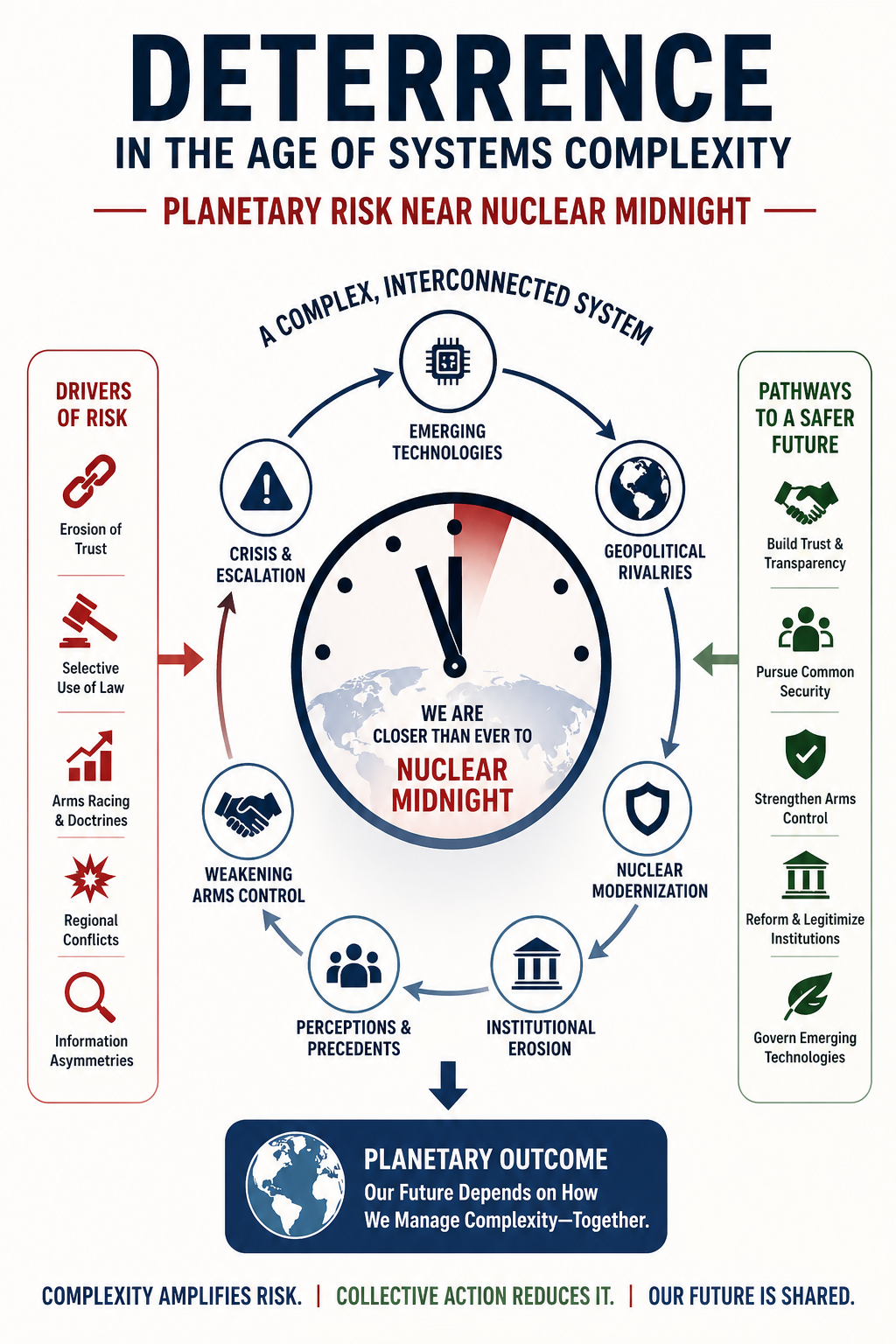
The global nuclear landscape is entering a new phase defined not simply by the number of weapons, but by the complexity of the system in which deterrence operates. We are approaching what can be described as “nuclear midnight,” not only because of geopolitical tensions, but because the underlying system that once stabilized those tensions is becoming more fragmented, interconnected, and less predictable.
Deterrence, long treated as a stabilizing doctrine, is now embedded within a complex adaptive system shaped by technological acceleration, distributed knowledge, and shifting power structures. In this environment, risk is no longer linear or contained. It emerges from interactions across domains, including nuclear forces, artificial intelligence, cyber systems, and space capabilities, each influencing the other in ways that are difficult to anticipate or control.
The Treaty on the Non-Proliferation of Nuclear Weapons, historically the foundation of global nuclear governance, is under simultaneous strain across its pillars of nonproliferation, disarmament, and peaceful use of nuclear energy. Arms control frameworks are weakening, deterrence doctrines are expanding, and decision timelines are compressing under technological pressures.
Taken together, these dynamics point to a deeper reality. The world is not simply facing heightened nuclear danger. It is confronting planetary-scale risk emerging from a system whose complexity is outpacing the structures designed to manage it.
2. The Erosion of the Foundational Bargain
The Non-Proliferation Treaty rests on a grand bargain. Non-nuclear weapon states agree to forgo nuclear weapons. In return, nuclear weapon states commit to pursue disarmament and provide a framework for equitable security and peaceful nuclear cooperation.
That balance is now widely perceived as uneven.
Disarmament commitments remain largely declaratory, while nuclear weapon states continue to modernize and expand their arsenals. At the same time, nuclear deterrence is not being reduced in importance but normalized and extended.
This creates a powerful systemic signal that shapes behavior more than formal commitments.
States that possess nuclear weapons appear to secure strategic immunity.
States that do not may remain exposed to coercion or intervention.
In systems thinking, such signals act as feedback loops. They influence future decisions more strongly than legal frameworks or diplomatic statements. Complexity science reveals that modern conflicts are not reducible to bilateral disputes but consist of overlapping systems of actors, narratives, and incentives. Each actor’s behavior alters the collective environment, creating recursive feedbacks that may amplify trust or fear.
3. The Crisis of Institutional Trust
International institutions were created to stabilize this system and provide neutrality, verification, and legal consistency. These include:
The United Nations, tasked with maintaining international peace and security.
The International Atomic Energy Agency, responsible for nuclear safeguards and verification.
The International Court of Justice, intended to uphold international law impartially.
However, the perception in many parts of the world is that these institutions are no longer functioning as neutral arbiters, but as asymmetric instruments within a power-structured international order.
This perception is shaped not by a single event, but by accumulated patterns.
The role of the International Atomic Energy Agency in Iraq, Libya, and more recently Iran has raised difficult questions. In principle, safeguards are designed to ensure compliance and build confidence. In practice, some states perceive that inspection regimes can expose strategic vulnerabilities, which may later be exploited in conflict. Whether or not this perception is accurate, its existence has strategic consequences.
Similarly, the selective implementation of United Nations resolutions, particularly in highly visible conflicts, has contributed to a growing belief that international law is applied unevenly. Decisions of the International Court of Justice, including those related to ongoing humanitarian crises, are viewed by some as lacking consistent enforcement.
Even when these institutions act within their mandates, the perception of selective application or political influence undermines their legitimacy.
In complex systems, legitimacy is not defined solely by intent or structure, but by how actors interpret outcomes.
4. From Rules-Based Order to Precedent-Based Behavior
As trust in institutions declines, state behavior shifts accordingly. Instead of relying on formal rules, actors begin to respond to observed precedents.
Recent decades have reinforced a troubling pattern in the perception of many states.
Countries that relinquished strategic deterrence capabilities faced instability or external intervention.
Countries that possess or develop nuclear capabilities appear to deter such outcomes.
This creates a reinforcing loop. The perceived value of nuclear deterrence increases not because it is morally justified, but because it appears strategically effective.
The result is a gradual shift from a rules-based order to a precedent-based system, where decisions are guided by observed outcomes rather than agreed principles.
5. Complexity, Technology, and System Instability
At the same time, the system is becoming more complex and less predictable.
Nuclear risk is no longer confined to weapons themselves. It is increasingly shaped by interactions with other domains, including artificial intelligence, cyber systems, and space-based technologies.
Artificial intelligence is being integrated into command and control systems, potentially reducing decision times and increasing the risk of miscalculation. Cyber vulnerabilities introduce new pathways for disruption. The militarization of space adds another layer of strategic instability.
These developments do not operate in isolation. They interact with geopolitical tensions, institutional distrust, and regional conflicts, creating a multi-layered risk environment.
In such a system, failure is more likely to emerge from unintended interactions than from deliberate decisions.
6. The Limits of Traditional Approaches
Efforts grounded in dialogue, scientific exchange, and incremental risk reduction remain essential to sustaining international security. Over decades, such approaches have helped bridge divides and reduce tensions even in periods of deep geopolitical rivalry.
However, they are increasingly operating within a system where underlying assumptions are shifting. Expectations of shared norms, consistent adherence to international law, and gradual convergence toward disarmament are being challenged by competing strategic interests and asymmetries in power and enforcement.
This does not diminish the value of these approaches. Rather, it highlights the need to extend them beyond technical risk reduction to include structural balance, institutional credibility, and perception management.
7. Strategic Pathways for States
The evolving nuclear landscape requires recognizing that responsibility for system stability does not rest with one group of states alone. Both nuclear-armed and non-nuclear states operate within, and shape, the same system. Effective pathways forward must therefore reflect differentiated roles, capabilities, and responsibilities, while acknowledging the interconnected nature of security.
7.1. Nuclear-Armed and Nuclear-Capable States
Nuclear-armed states remain central to the stability or instability of the global system. Their doctrines, postures, and actions define the strategic environment within which all other states operate. As such, their responsibilities extend beyond national security to the preservation of global order.
A critical step is restoring credibility to disarmament commitments. This does not necessarily require immediate large-scale reductions, but it does require visible, measurable, and time-bound actions that demonstrate alignment between declared intentions and operational realities. Without such signals, the gap between commitment and conduct will continue to widen, reinforcing incentives for proliferation elsewhere.
Doctrinal evolution is equally important. The continued expansion of nuclear deterrence roles contributes to the normalization of nuclear weapons as instruments of security. A gradual shift toward doctrines that reduce reliance on nuclear weapons can help reverse this trend.
Transparency must also be strengthened. Even in competitive environments, structured and reciprocal transparency measures can rebuild a minimum level of predictability and reduce the likelihood of miscalculation.
At the same time, restraint in the integration of emerging technologies is essential. The incorporation of artificial intelligence, cyber capabilities, and space-based systems into nuclear command and control introduces new layers of uncertainty that must be carefully managed.
Finally, nuclear-armed states play a decisive role in shaping perceptions of fairness. Consistent adherence to international law and constructive engagement with multilateral institutions are essential for restoring confidence in the system.
7.2. Non-Nuclear States
Non-nuclear states are often portrayed as passive participants in the nuclear order. In reality, they possess significant agency, particularly when acting collectively and strategically.
In a fragmented system, collective action becomes a primary source of influence. Regional groupings, cross-regional coalitions, and nuclear weapon free zones provide platforms through which non-nuclear states can shape norms and expectations.
Security concepts also require redefinition. The pursuit of common security offers an alternative to reliance on extended deterrence frameworks that may not always provide reliable guarantees.
Non-nuclear states can also advance transparency and accountability by advocating for measurable benchmarks and strengthened verification mechanisms.
Engagement with emerging technologies is critical. Participation in shaping governance frameworks for artificial intelligence and dual-use systems can help mitigate risks early.
At the same time, some states may explore forms of strategic resilience that do not involve nuclear weaponization but enhance national security.
Underlying all these pathways is a broader shift. Non-nuclear states are no longer operating from a position of technological or informational disadvantage. Their growing capabilities position them as active contributors to the design and evolution of the global security system.
8. A System at a Crossroads
The current trajectory suggests three possible futures.
A continuation of the present path, where the system persists but becomes increasingly fragile.
A breakdown scenario, where proliferation accelerates and norms erode.
A transformation, where the system is redesigned to reflect contemporary realities.
The direction taken will depend less on formal declarations and more on whether the system can restore credibility, balance, and inclusiveness.
9. Conclusion: From Dominance to Legitimacy
The nuclear order was built in a different era, under assumptions shaped not only by power, governance, and cooperation, but also by asymmetries in access to information, technology, and institutional influence. That context has fundamentally changed. Today, a far broader group of nations possesses advanced scientific, technological, and strategic capabilities, operating within a world defined by distributed knowledge, interconnected systems, and rising expectations of equity and agency.
In this environment, deterrence no longer operates in isolation. It is embedded within a system of increasing complexity, where interactions across nuclear, technological, and geopolitical domains generate risks that are difficult to predict and even harder to control. The challenge is no longer confined to preventing deliberate nuclear conflict. It is the management of planetary risk arising from a tightly coupled, complex system moving toward instability.
As the world approaches nuclear midnight, the question is not only whether deterrence can hold, but whether the system that sustains it remains credible, balanced, and resilient. Stability in such a system cannot be maintained through dominance alone. It depends on legitimacy, consistency, and shared responsibility across all actors.
Without these conditions, the logic of deterrence will continue to diffuse through the system, reinforcing itself through perception and precedent. With them, there remains a pathway to reshape the system toward one in which complexity is managed, risks are reduced, and security is understood as a collective planetary condition rather than a competitive national construct.
Sources and Further Reading
- Pugwash Conferences on Science and World Affairs, The NPT at a Crossroads, April 2026
- Treaty on the Non-Proliferation of Nuclear Weapons (1968)
- International Atomic Energy Agency, Safeguards and Verification Frameworks
- United Nations Charter and Security Council Resolutions
- International Court of Justice rulings and advisory opinions
- Stockholm International Peace Research Institute, Global Nuclear Forces Reports
- Federation of American Scientists, Nuclear Weapons Data
- Arms Control Association, Nuclear Agreements Overview
- Bulletin of the Atomic Scientists, Doomsday Clock