From Maimonides to Modern Engineers: The Highest Form of Charity for a Resilient and Sustainable World
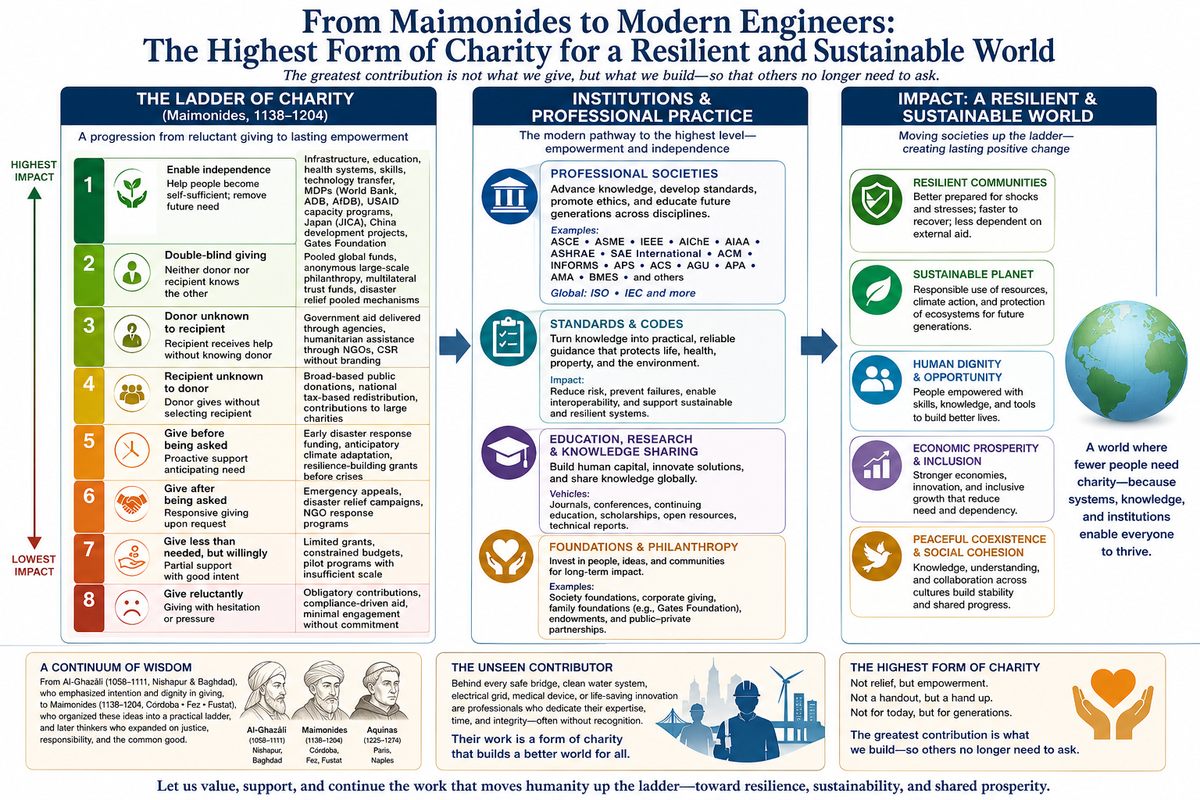
Rethinking Charity in an Age of Complexity
When we hear the word charity, we tend to picture visible acts of giving, donations that provide immediate relief in times of need. These acts are important and often lifesaving. Yet many of the most consequential contributions to human well-being are neither visible nor recognized as charity at all. They operate quietly, embedded within the systems that sustain our daily lives.
Nearly nine centuries ago, the philosopher and physician Moses ben Maimon (1138–1204), known in Arabic as Mūsā ibn Maymūn (موسى بن ميمون) and widely referred to as Maimonides, offered a deeper and more enduring perspective. Born in Córdoba (Al-Andalus), he later lived in Fez (Morocco) and ultimately in Fustat (Old Cairo, Egypt), where he served as a leading physician and scholar, he developed his influential “ladder of charity” within the Mishneh Torah.
Rather than measuring charity by the amount given, he focused on how it is given and, more importantly, on its long-term effect on human dignity and independence. At the top of this ladder is not generosity in the conventional sense, but something far more transformative: enabling a person to become self-sufficient .
In a world increasingly shaped by climate risk, infrastructure fragility, and constraints on natural resources, this idea takes on renewed relevance. The highest form of charity today may lie not in direct aid, but in the creation of resilient systems, sustainable practices, and shared knowledge that allow communities to thrive without needing aid at all.
The Ladder of Charity — A Simple, Enduring Framework
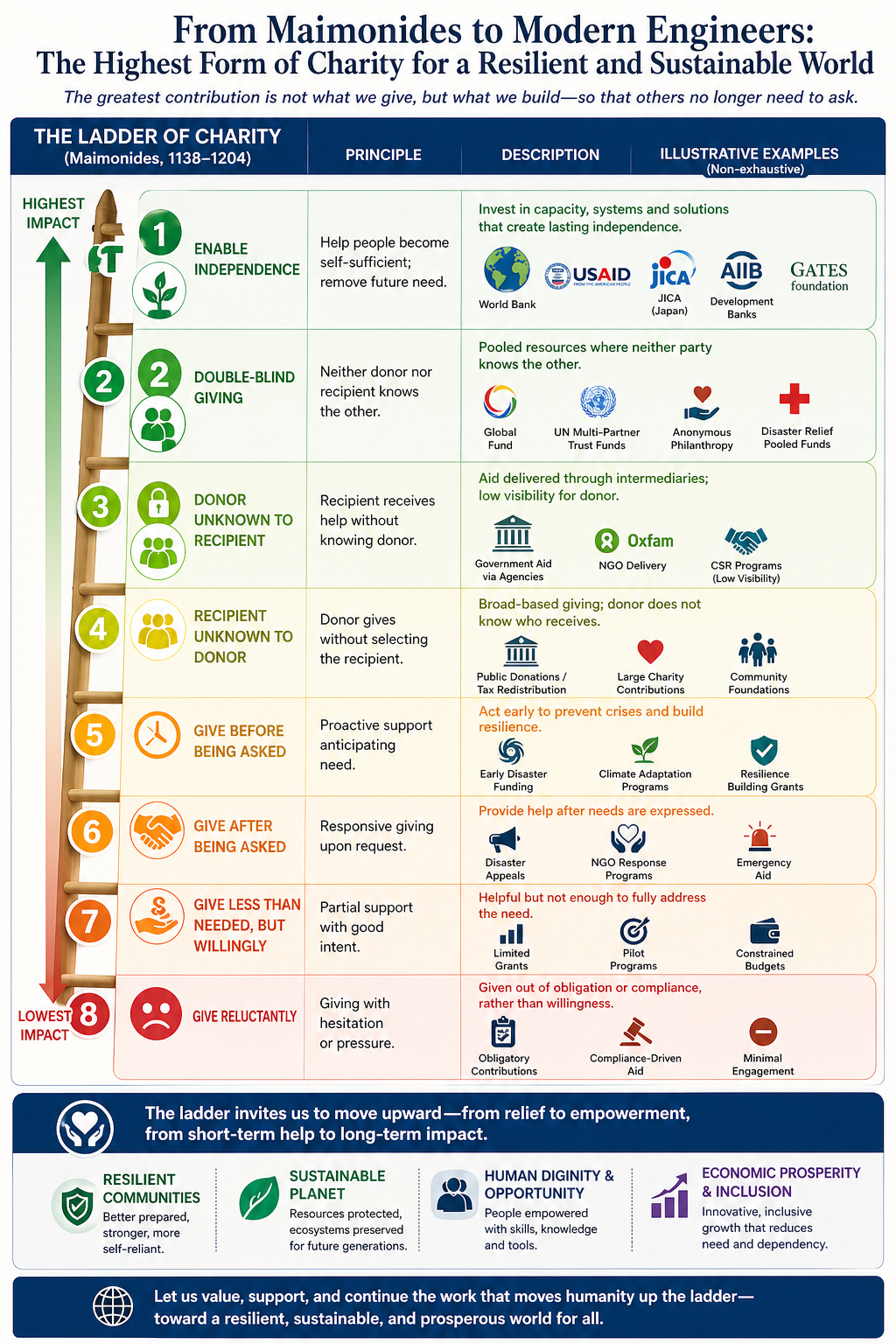
Maimonides described eight levels of giving. While originally expressed in legal and ethical terms, the ladder can be summarized in a simple and memorable way. To connect this classical framework with modern practice, Figure 1 offers illustrative, not prescriptive, examples across governments, development institutions, and philanthropy, noting that modern research has further examined how people perceive different forms of giving, showing that the manner of giving can matter as much as the amount, and the illustrative examples are broad and non-exclusive, reflecting different modes of giving rather than ranking specific institutions. This progression moves from reluctant obligation to transformative empowerment. What distinguishes the highest level is not generosity alone, but the elimination of future need.
The Ladder as a Framework for Resilience and Sustainability
Maimonides’ ladder can also be understood as a framework for systems thinking. The lower levels respond to immediate needs, while the higher levels address the underlying causes of those needs. At its highest level, charity becomes indistinguishable from capacity-building: providing tools instead of temporary relief, building systems instead of one-time assistance, and preserving dignity while enabling independence.
Two principles emerge clearly. First, dignity matters as much as outcome. Second, long-term resilience outweighs short-term relief. These principles align closely with modern understandings of community resilience and sustainability. Resilience reflects the capacity of communities to withstand and recover from disruption, while sustainability ensures that present needs are met without compromising those of future generations. Both aim to reduce dependency by strengthening systems so that repeated intervention becomes unnecessary.
Intellectual Context: From Al-Ghazālī to Maimonides and Beyond
Maimonides’ work did not emerge in isolation. It developed within a rich intellectual tradition shaped by earlier scholars, including Abū Ḥāmid al-Ghazālī (1058–1111), one of the most influential thinkers of the Islamic world. Al-Ghazālī lived and taught in Nishapur (Persia) and later at the Nizamiyya Madrasa in Baghdad, where he explored the ethics of intention, sincerity, and moral conduct, including the ethics of giving.
Al-Ghazālī emphasized that the value of charity lies not only in the act itself but in the purity of intention, the avoidance of self-interest, and the protection of the recipient’s dignity. He cautioned that charity could lose its moral value if it fostered dependence or diminished the recipient.
By the time Maimonides was writing in Fustat (Cairo) in the late twelfth century, these ideas were already part of a broader intellectual environment shaped by Arabic philosophical and theological discourse. Writing in Arabic and engaging deeply with this intellectual context, Maimonides can be seen as systematizing and structuring these ethical principles into a clear, operational hierarchy.
Later thinkers continued to develop these ideas. Nachmanides (1194–1270), working in Girona and later Jerusalem, expanded on dignity and responsibility in giving, while Thomas Aquinas (1225–1274), teaching in Paris and Naples, linked charity to justice and the common good.
Across these thinkers, a shared principle emerges:
the highest form of giving is that which strengthens the recipient, preserves dignity, and reduces future need.
A Subtle Historical Thread: Knowledge, Coexistence, and Capability
Maimonides’ life reflects a deeply interconnected intellectual world. Writing in Arabic and engaging across traditions, he lived within societies where knowledge circulated across cultures. During certain periods, particularly in parts of the medieval Middle East and North Africa, conditions of relative openness enabled the preservation and advancement of knowledge.
Without overstating any single narrative, such environments supported the participation of diverse communities in intellectual and economic life. This fostered not only learning but also capability.
The broader lesson is that when knowledge is cultivated and shared, dependency diminishes and resilience grows. When coexistence is enabled, innovation is strengthened. These are subtle but powerful forms of charity—forms that build lasting capacity rather than provide temporary relief.
From Civilizations to Institutions: The Rise of Professional Societies
In the modern era, the role once played by civilizations in fostering knowledge has increasingly been assumed by institutions, particularly professional societies. These organizations serve as custodians of collective expertise across disciplines.
Engineering institutions such as the American Society of Civil Engineers, the American Society of Mechanical Engineers, and the Institute of Electrical and Electronics Engineers have shaped the built and technological world. Complementary organizations such as the American Institute of Chemical Engineers, the American Institute of Aeronautics and Astronautics, ASHRAE, and SAE International advance specialized domains.
Beyond engineering, knowledge ecosystems extend into computing, science, planning, and medicine through organizations such as ACM, INFORMS, APS, ACS, AGU, APA, AMA, and BMES. At a global level, ISO and IEC provide standards that transcend borders.
Through research, education, ethical guidance, and standards development, these institutions enable societies to function safely, efficiently, and independently. In doing so, they embody a modern, institutional form of the highest level of charity.
Standards: The Invisible Architecture of Charity
Few contributions illustrate this idea more clearly than standards. When systems function safely and reliably, it is often because knowledge has been codified and applied consistently over time.
Standards reduce risk, prevent harm, and protect lives at scale, yet remain largely invisible. Their success is measured in what does not happen, failures avoided, disasters prevented.
In this sense, standards represent a form of charity that prevents suffering before it arises. They preserve dignity and operate without seeking recognition, aligning with the insight that how something is given shapes how it is valued .
Community Resilience Through Professional Practice
Resilience is built through foresight. Professionals contribute by designing systems that anticipate risk and adapt to change, enabling communities to withstand and recover from disruption.
Over time, these efforts reduce dependence on external aid and strengthen self-reliance. This reflects movement up the ladder, from reactive support to proactive capability.
Sustainability: Extending Charity Across Generations
Sustainability extends the concept of charity into the future. By ensuring responsible resource use and preserving environmental systems, it prevents future need.
This introduces an intergenerational dimension: charity is not only about helping today, but about ensuring that tomorrow does not require the same help.
The Role of Foundations and Knowledge Investment
Professional societies extend their reach through foundations that support education, research, and outreach. These efforts provide immediate opportunities while building long-term capability.
Knowledge, in this sense, becomes one of the most powerful and scalable forms of charity.
The Professional as an Unseen Contributor
At the center of these systems are individuals whose contributions often remain unseen. Professionals develop standards, share knowledge, and mentor others.
Their work reflects the highest principles of the ladder: enabling others, strengthening systems, and contributing without seeking recognition.
The Value We Overlook
Society often recognizes visible charity while overlooking the systems that quietly sustain it. When these systems are undervalued, resilience weakens.
Recognizing them as forms of charity is essential to sustaining long-term societal well-being.
A New Interpretation for Our Time
Maimonides’ insight remains relevant: the highest form of charity is empowerment. Today, this includes resilient systems, sustainable practices, and shared knowledge.
Conclusion: Building a World That Needs Less Charity
The ultimate goal of charity is to make itself unnecessary.
From Al-Ghazālī’s ethical foundations to Maimonides’ structured framework and into modern institutions, a consistent message emerges:
The greatest contribution is not what we give, but what we build, so that others no longer need to ask.
Sources
- De Freitas, J., DeScioli, P., Thomas, K. A., & Pinker, S. (2019). Maimonides’ Ladder: States of Mutual Knowledge and the Perception of Charitability. Journal of Experimental Psychology: General.
- Maimonides (Moses ben Maimon, 1138–1204). Mishneh Torah, Laws of Gifts to the Poor.
- Al-Ghazālī (1058–1111). Iḥyāʾ ʿUlūm al-Dīn (Revival of the Religious Sciences).
- Aquinas, T. (1225–1274). Summa Theologica (sections on charity and justice).