Global Catastrophic Risk and the Imperative of Playing the Players for Peace

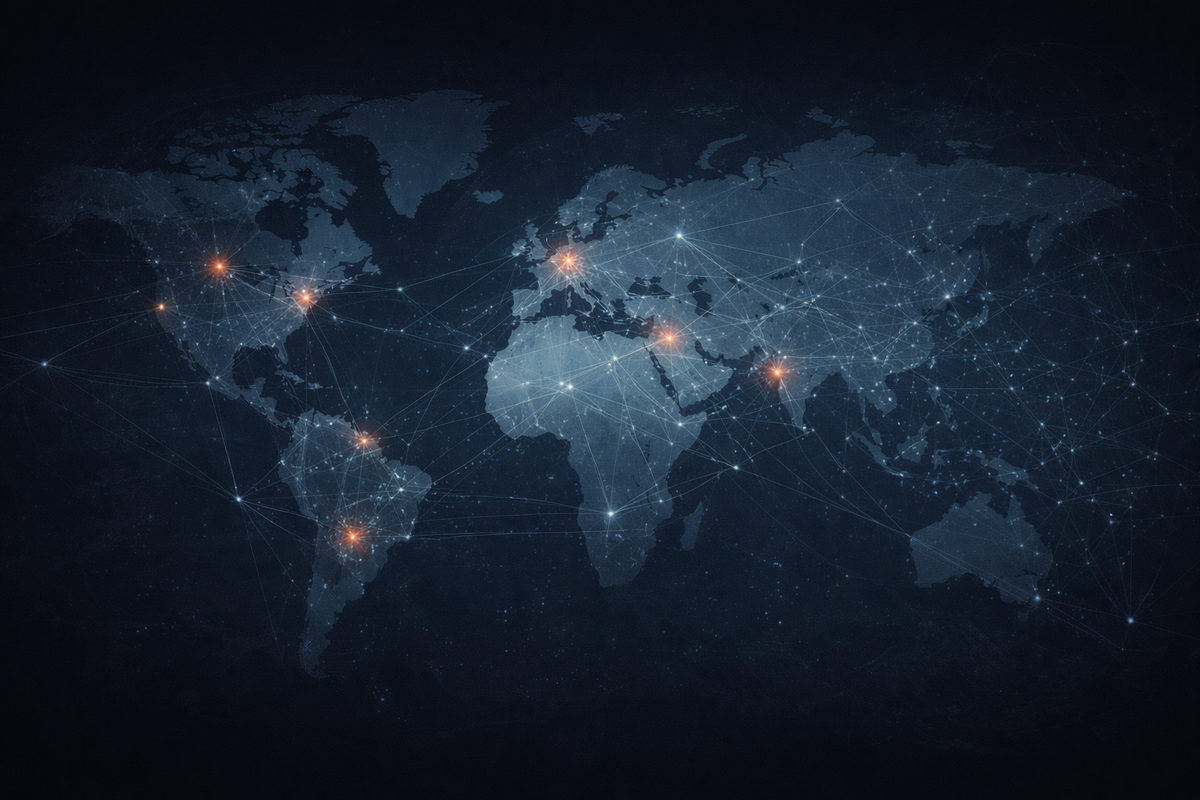
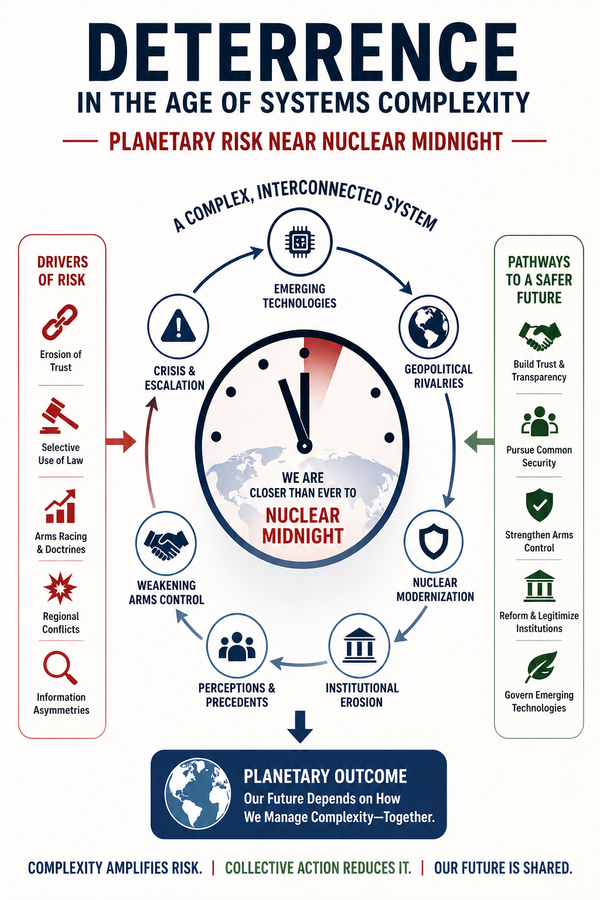
We are living in a moment where geopolitical tensions are increasingly nested within complex alliance systems, nuclear doctrines, domestic politics, and rapid information flows. In such systems, escalation is rarely linear. It is systemic.
As discussions of military confrontation intensify in the Middle East, we must examine not only immediate tactical decisions, but the structure of the conflict system itself. The risk of miscalculation cascading across interconnected actors represents a form of global catastrophic risk, one that demands complexity-informed diplomacy rather than reactive escalation.
As tensions escalate in the Middle East with Israel and the United States contemplating military action against Iran, and regional and global actors positioning themselves we must confront a sobering reality:
The risk of escalation is not linear.
In a tightly interconnected geopolitical system, local military action can propagate across alliances, deterrence structures, and nuclear doctrines. The possibility, however remote of miscalculation cascading into large-scale or even nuclear confrontation cannot be dismissed.
This is not alarmism. It is systems thinking.
Conflicts at this scale behave as complex adaptive systems, with fractal properties that repeat across levels, from local, regional, and global. Strategic signaling, risk attitudes, identity, domestic politics, and alliance networks interact in nonlinear ways. Small shifts can produce outsized consequences.
In a recent paper, Play the Players for Winning Peace: Complexity Analytics with the UK-Ireland Good Friday Agreement as a Case Study, I proposed a framework for analyzing and resolving intractable conflicts through:
- Complexity science
- Game theory
- Network and hypernetwork analytics
- Bayesian updating of dynamic assessments
- AI-driven scenario modeling
- Psychological and risk-attitude profiling
Source: https://scholarworks.umb.edu/cgi/viewcontent.cgi?article=1911&context=nejpp
This approach was recently published in my 2025 paper on "Play the Players for Winning Peace,"
and
A book chapter on Ending Wars. Also it was presented at the 2025 Pugwash Conferences on Science and World Affairs 2025.
The central idea is simple but profound:
In complex conflicts, it is not enough to analyze the situation.
We must “play the players.”
This does not mean manipulation. It means understanding.
It means mapping:
- Risk tolerances
- Rationality spectra (from redline behavior to calculated trade-offs)
- Psychological profiles
- Alliance structures
- Information flows
- Identity commitments
Game theory reminds us that conflicts can resemble Prisoner’s Dilemma, Chicken, Deadlock, or Perceptual Dilemma structures (see Figure 1 in the paper). In nuclear contexts, perceptual misinterpretation alone can prevent mutually beneficial de-escalation. Bayesian updating (Section 3.2) reminds us that decisions should evolve as new information arrives, yet escalation environments often harden positions rather than update beliefs. Network analysis (Section 3.3) shows that conflicts are not bilateral; they are multi-layered hypernetworks. External actors, regional powers, global powers, non-state groups, create nested structures where intervention at one node affects the entire topology.
In such systems, traditional reactive diplomacy is insufficient.
What is required is strategic engagement grounded in an honorable value system of integrity, restraint, and long-term peace, rather than short-term dominance.
The case study in the paper covers the Good Friday Agreement to demonstrate that even deeply entrenched conflicts can shift when:
- Risk perceptions are recalibrated
- Identity narratives are reframed
- External actors provide stabilizing leverage
- Long-term institutional pathways are built
The stakes in the present geopolitical moment are far greater.
Escalation among nuclear-capable actors would not be a regional event. It would be a global catastrophic risk, economic collapse, humanitarian crisis, environmental consequences, and irreversible geopolitical fragmentation.
We therefore need:
- Leadership willing to update beliefs
- Diplomacy informed by complexity analytics
- AI tools used for de-escalation modeling, not battlefield optimization
- Strategic communication designed to reduce misperception
- A long-game approach grounded in sustainable peace
The key question is not who can win. It is whether humanity can avoid losing.
I invite colleagues in risk analysis, engineering, economics, security studies, and policy:
➡ How can complexity analytics and AI-driven modeling be used proactively for de-escalation?
➡ What mechanisms best reduce perceptual dilemmas in high-stakes nuclear environments?
➡ How can we quantify escalation risk in interconnected alliance networks?
The world does not need better war games. It needs better peace strategies.